Author: Barbara Bamberger Scott

  • MASTER OF WESTFALL PLANTATION by Bonnie Stanard, a historical novel

    MASTER OF WESTFALL PLANTATION by Bonnie Stanard, a historical novel

    Bonnie Stanard exposes some of the greatest plights of those who suffered from human bondage and slavery in her book Master of Westfall Plantation. Readers will be pulled into the novel’s eloquent prose that paints the tragic moments of the antebellum South. This captivating and well-researched story will resonate with you long after you read the final page.

    Set in Charleston, South Carolina and a nearby island shortly before the Civil War, the book introduces the central character Tilmon Goodwyn. He is cold toward his beautiful wife Georgiana (who is secretly shamed by her humble background), manipulative and suspicious of his widowed mother Phoebe, (who may be flirting with a sophisticated con man), and extremely cruel to slaves (while believing himself benevolent).

    Tilmon blunders through the business of running a large plantation, yet, underpinned by the pernicious institution of slavery, manages to prosper nonetheless. Given to gambling and pleasing himself, he has already impregnated one slave and developed a seething lust for another—young Kedzie, who has a mind towards freedom and a deep hatred of her master that only stirs his passion more.

    Passing his days in questionable business dealings, watching as his foreman lashes his slaves for the smallest infractions, Tilmon gives us little to like. The only time this arrogant husband, indifferent father, maladroit manager, and cruel overlord shows a smidgen of tender feeling is when Billy, a favorite slave, dies, probably having ingested poison meant for Tilmon himself—but administered by whom?

    Meanwhile Georgiana, meeting by chance with the abolitionist preacher who raised her, plots to have Kedzie sent north via the Underground Railroad, not in sympathy for the girl’s terrible circumstances, but as revenge for her husband’s flagrant infidelity.

    In a telling moment, Georgiana hears the laughter of gypsies and wonders how “a person of such poor circumstance could find anything funny,” not grasping that it is freedom, not wealth, which brings happiness. Readers will no doubt want to cling to hope for Kedzie to find a way out of hardship. As the novel ends, there are muted mentions of events in Kansas and elsewhere that may influence Tilmon’s dark empire that he rules with an iron hand and a perverted morality.

    Bonnie Stanard is a freelance writer and editor whose skills come to the fore in this work, with finely honed language that at times borders on the poetic. Master of Westfall Plantation is part of a series, for which Stanard has assiduously researched her subject matter, even attaching a lengthy bibliography. She focuses on the evil of slavery, expressing, in a brief introduction, her conviction that “a man of good will who conforms to a bad culture is more bad than good.”

    The hopeless plight of those who suffered from human bondage and slavery is fervently depicted in the authentic voices of the “low country.” Stanard’s portrayal of Tilmon and other slave masters who believed themselves “righteous and good” chronicles the juxtapositions that permeated the antebellum South. This unrelenting pessimism and, at times, almost complete lack of even a ray of hope can make the read intense and uncomfortable. Nevertheless, Master of Westfall Plantation is a brilliant work speaking honestly of an unspeakable wrong.

    The Master of Westfall Plantation is a companion novel to Kedzie, Saint Helena Island Slave (2012),  Sonny, Cold Slave Cradle (2013), and Westfall, Slave to King Cotton (2014). All four novels compose the well-researched and well-told Westfall series by Bonnie Stanard.


  • KISMET OR KAMASUTRA by Martha Rather, Book 3 in the Romantic India Series

    KISMET OR KAMASUTRA by Martha Rather, Book 3 in the Romantic India Series

    A tour guide in India and a practitioner of Healing Touch, Sonia has a country farmhouse in Nashville, loyal friends, a generous but unfaithful husband, a flame on the other side of the world who seems to have forgotten her, and … breast cancer.

    This highly engaging story, Part 3 of the series Romantic India by author Martha Rather, begins with Sonia burning up her “chemo pajamas” with her best friend, Clara Mae, in a wild “Freedom Fire Ceremony.”

    We learn in flashbacks the very real fear and agony Sonia experienced in her two-year struggle with breast cancer, losing her memory and almost losing her mind. Now she faces losing Carl, her antique dealer hubby, who prowls for old furniture by day and sweet young things by night.

    Sonia pals around with a lawyer friend, Bob, though she dreams, frustrated, of handsome Raj, her fellow tour guide and Indian prince who, she is told, is about to get married on the other side of the world.

    When Sonia and her friends are tapped to squire some struggling musicians across India, it’s a chance to re-establish trust with the still-single Raj, break with Carl forever, and watch the haunting dreams of previous lifetimes unfold in this one.

    Following the old dictum that writers should write about what they know, the author, like her heroine Sonia, has roots in South Dakota, lives in Nashville, has traveled extensively in India, and is a practitioner/instructor for Healing Touch International. Martha Rather writes in a wonderful girlfriend manner as though she is a dear friend catching us up on the latest happenings. She also seems as much at home with Southern accents as with Hindi street talk.

    Settings, too, are a highlight, from a plain old Tennessee farmhouse to the romantic majesty of the Taj Mahal. There is rarely a moment when the action lags. The first half of the book, with its vivid descriptions of Sonia’s battle with chemo and radiation treatments, projects a depth of self-exploration and insights. Readers are then taken on a rollicking jaunt through India, with a group of self-important musicians and tourists in tow, for the second half of the story.

    Nonetheless, Martha Rather is careful to keep emotions and libidos always on the boil for her intended readers who enjoy stories filled with intrigue, romance, friendships, adventures, handsome princes, and, maybe, a flirtatious elephant thrown into the mix.   

    Kismet or Kamasutra is a journey of self-discovery and the possibility of changing one’s stars.  Kismet means destiny; fate and Kamasutra mean desire, but which one will win out?  In this uplifting and transporting novel of love and connection, Sonia and Raj must confront their worst fears and the fateful patterns that started a thousand years before.

  • GUIDED to WISDOM: The JOURNEY to EMOTIONAL HEALING by Susan D’Agostino

    GUIDED to WISDOM: The JOURNEY to EMOTIONAL HEALING by Susan D’Agostino

    Susan D’Agostino has wisdom to share, garnered from a lengthy battle with cancer and the medical establishment. This is her intimate story.

    “In 2002 I found a lump in my breast, maybe the size of a pea.” Like anyone faced with a possible dire diagnosis, D’Agostino was scared and confused. Her encounters with medical people left her feeling like a statistic, and when she got the dreaded prognosis after a painful biopsy, it was accompanied by the standard recommended next steps: months of chemo and radiation treatment. Fearing the treatment almost as much as the cancer, she sought alternative healing methods.

    She consulted a variety of therapists—naturopaths, herbalists—and certain ones seemed like soul mates. In her search, she began to see signs: a strange affinity for the number 1111, a hawk landing and sitting in her yard. She began to trust her intuition; despite being prodded by the oncologist to get the standard treatment, she finally decided it wouldn’t be right for her. In the next few years, she became thoroughly immersed in her “mission”. She learned meditation, took yoga classes, eliminated aluminum products (like deodorants) from her life, began journal-ling, had colonics and kinesiology, and discovered automatic writing, leading her to her inner voice and a higher level of guidance.

    One day she said “I knew I was finished” with the medical establishment’s treatments, and despite ominous letters sent by the oncologist predicting her demise if she stopped, tests showed that the cancer was gone. After resigning from her day job, she realized she could help others, and has remade her professional life as an Emotional Healer and Journey Practitioner.

    D’Agostino’s saga is compellingly dramatic in the early pages, as the reader suffers with her and cheers her along on her personal mission. She has found her feet as a writer, staging her story skillfully, and frankly revealing the fears and rages that she believes were part of her inner cycle of “dis-ease” and healing. The last third of the book reinforces her positive messaging and could be used as a workshop tool for positive messaging and mediation. D’Agostino delivers a powerful and succinct message about hope and change in the subjective, human story that she shares. She reminds us that we are not alone.

    Doubtless a vehicle to inspire others who find themselves or loved ones in a similar, life-threatening plight, Guided to Wisdom offers a heart-rending true story along with responsible and valuable advice to consider when deciding treatments and alternative methods of healing and self-healing. Overall, with her treatise Guided to Wisdom: The Journey of Emotional Healing, D’Agostino implores us to look inside ourselves for answers to life’s challenges and to trust our intuition. 

  • The Man With the Overcoat by David Finkle; a contemporary NYC novel

    The Man With the Overcoat by David Finkle; a contemporary NYC novel

    Arts writer David Finkle’s anti-hero, Skip Gerber, has many obligations—lukewarm devotion to his sort-of fiancé, obedience to his smother-mother, loans to his ne’er-do-well brother, and a tedious job at a New York City law firm founded by his father. But in the space of twenty-four hours, all that could change.

    It starts with an overcoat, handed to Skip as he’s leaving work one ordinary late afternoon, shoved into his hands by an anonymous man with these words: “Here you go, and be very careful with it.” Minutes later, Skip realizes he’s stuck with the coat and starts trying to figure out how to get rid of it on his way to a supper date with his fiancé. He begins to examine the coat, tries it on, and finds it to be of unusually good quality and, also remarkably, a perfect fit. Inventorying various items he finds in the pockets, he embarks on a mission to return the coat to its rightful owner.

    He roams the city on foot and by taxi, being tailed in traffic by a mysterious black limo and, on the sidewalk, by two young thugs in hoodies, constantly checking his cell phone for calls from the increasingly peeved fiancé, his nagging mother, and his brother trying to cadge a loan. But Skip gradually gets too wrapped up in the enigma of the coat to care about these distractions.

    Everyone he encounters tells him what a great garment he has acquired. Voice mails remind him to take care of it. Hustling uptown, downtown, and all around the park, following clues seemingly emanating from the coat, he goes from a once grand building that might have offered a hint about the coat’s owner, to the statue of a man holding what looks to be the selfsame coat, to an abandoned tailor’s shop where perhaps the coat was created.

    As the hours pass—compulsively checked on his fake Rolex—his fiancé dumps him by voice mail, his brother divests him of some cash, and he drops his childhood nickname. The coat yields more intriguing clues: a weird stone that might be a Mayan artifact and a shiny Indian-head penny.

    David Finkle is a New York based writer (The New York Times, The New Yorker, The Village Voice) who knows his setting well, describing the city and its denizens vividly. He strews bon mots through the narrative like a man feeding pigeons in the park, and deftly guides the reader through the increasingly complex thought processes of an erudite Everyman with an overcoat that gradually becomes a symbol of quality—quality of cloth and tailoring, quality of life.

    Twenty-four hours after he was the coat was thrust in hands, Edward has followed his instructions to care for it, has chased down his clues, and knows what to do next. The Man With the Overcoat by David Finkle is an entertaining top-shelf work of contemporary fiction that blends mystery, fantasy, and comedy. This is a tightly written story with rich and complex subtext that makes reading it a sublime pleasure.


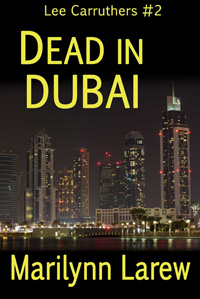
  • DEAD in DUBAI by Marilynn Larew; an international spy thriller

    DEAD in DUBAI by Marilynn Larew; an international spy thriller

    Larew has found a comfort zone in describing exotic settings, and her perspicacity for honing in on minute details gives her work a sense of authenticity. Through the eyes of her intrepid, intelligent heroine, we are treated to an insider’s view of locales like Dubai and Istanbul.

    In this second Lee Carruthers offering (The Spider Catchers provided the opening salvo), author Marilynn Larew again displays her prodigious knowledge of the international dealings in diamonds, deception and death that are hidden from the headlines.

    Employing her wry wit (“I disapprove of assassination, particularly my own”), Carruthers, a woman of a certain age (“my long brown hair had a few strands of silver”) is looking for a dead man. After quitting the CIA and vowing she wouldn’t go to Dubai to look for CIA operative George Branson, she is inveigled into doing just that by the appeals of Branson’s wife Cynthia, and possibly equally, by the little brass key that Cynthia gives her. Figuring out what that key unlocks will consume Carruthers; finding out why Cynthia plunges off a balcony to her death, and others will die while the hunt is on, will provoke far more troubling questions.

    Carruthers, a sort of female Bond, can identify a person’s borough of origin by his accent, and tell whether a man is an American or English by the way he takes his whiskey—with or without ice.  She knows where to get the best pastry, what wine to order, and in which Islamic enclave she can walk around without a head covering. She bribes passport control agents and befriends charming crooks. And she’s tough, always carrying a Glock, with a knife in a sheath on her leg.  She goes through several weapons in the course of this story, and uses a particular firearm to good effect occasioning one of the book’s better zingers: “Tears came to my eyes but they didn’t spoil my aim.”

    Carruthers is a person of principle, so when she gets caught up in a spy vs. spy morass, she keeps her own counsel and tries to do the right thing, though with the CIA and the Russian mafiya trying to outfox each other, she knows she may be seen as expendable. In the end, she has her ethics intact, a small bag of rough diamonds as compensation for her troubles, and some disturbing conclusions about who George Branson was, or is?—and who’s playing footsy with whom under the big table.

    In an age when national, ethnic and political identities and loyalties have blurred the lens of spy-craft, Larew’s heroine is right up to speed. And if the story line seems at times to move too fast and somewhat jerkily, it’s also true that there are few if any lulls in the action. Still, some readers may find the wrap-up final chapter rather mechanical, and may wonder why Carruthers, who keeps protesting that she quit the CIA in order not to be sent on dangerous assignments, hops on board for another missing-person case on the last page. But lucky for Larew’s readers that Carruthers accepts the assignments despite her better judgement.

    A sequel seems to be brewing that may perhaps reveal a softer side of Lee Carruthers. In this story there is a hint, but just: someone named Kemel, and a bloodstained pearl.

    Larew has built up steam with her fascinating femme-sometimes-fatale protagonist and her writer’s grip on the subtleties of international intrigue and double crossings that ratchets up the race against time in this spy vs. spy thriller.