
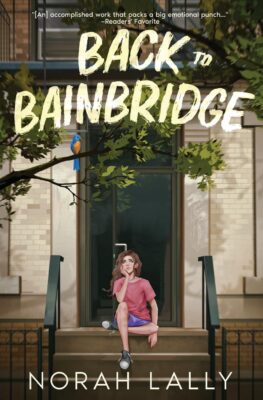

Title: Back to BainbridgeAuthor(s): norah-lallyPublisher: Abby Glen Press (2024)ISBN: 978-1-64704-872-3

 Village Books
 Amazon
 Norah Lally’s upper middle grade novel Back to Bainbridge sees unstable family life through the eyes of thirteen-year-old Vicki Hanlon. The story opens as her single mother has just lost another boyfriend, and the family is being evicted from their house in upstate New York.
Vicki’s memories, recalled as the family travels on the interstate down to grandmother’s apartment in the Bronx, shows the tumultuousness of her young life so far. It has left her with a world view based on disappointments, leaving friends, and the absence of a secure home.
To say Vicki’s family is dysfunctional would be an understatement. She can predict her life circumstances based on her mother’s relationships with men: happy, bereft, flirty, angry. As the eldest child, she cares for her siblings when her mother can’t despite how young Vicki herself is. Judith, her younger sister, wears her scars in the form of mistrust and cynicism, while her ten-year-old brother Dylan still clings to his stuffed bear as a small piece of reliable comfort.
Vicki’s mother deems their stay at grandmother’s home temporary, but also realizes she needs to change her life for her children’s sake. She promises this new beginning will be good for them all. Vicki can’t believe her, but one minute after meeting her grandmother she realizes this no-nonsense woman means business, and they need her for their very survival.
Vicki wants a stable home life, but she wants friends and a sense of belonging even more.
That first night in her grandmother’s home, she hears the voice of an angel. She opens the window and meets Rosa, the daughter of the building’s superintendent. They form an instant bond, and Vicki has her first friend inher new neighborhood. Then she meets James, the skater-dude whose problematic parents abandoned him to live with his aunt in the same apartment building. His parents’ past unruly behavior has left a bad impression on the other tenants, an unfortunate reputation that sticks to James like stale perfume. No one trusts him, not even Rosa, but Vicki won’t let anyone tell her who she can and cannot be friends with. She immediately sees something she likes in James and gives him the benefit of the doubt.
Vicki even refuses to judge her cranky downstairs neighbor, Mrs. Kirby, based on other people’s opinions. Word on the block is that she’s an old witch, but Vicki embraces everyone—a trait that proves invaluable as her friendships begin to blossom and change her view on the world.
When the talented Rosa leaves for a cultural-artistic summer camp, she entrusts the keys to her secret hideout with Vicki so that she can feed the rescued cats living in the basement against building rules. Vicki agrees but she has an ulterior motive for wantingthe keys; the ability to gain access to the basement storage units, especially the one holding her mother’s magenta bag. She suspects her mother has been keeping secrets about her father, whom she dreams of reuniting with in California.
What Vicki discovers in her exploration of the storage units surprises her. She uncovers forgotten treasures that tell the stories of her neighbors’ hidden lives, and as Vicki learns more about the multi-dimensional humans whom she sees each day, she realizes that there is truly more to everyone than what meets the eye, and she has empathy for them all.
Through her experiences, Vicki comes to respect the people of Bainbridge Avenue, and she becomes a builder of bridges, not walls, until even her own mother opens up to her and they grow closer.
The changes that occur over the course of this novel in Vicki, her family, and her new friends on Bainbridge Avenue show us the power of respect and understanding to heal and create lasting bonds. Vicki embraces acceptance and forgiveness, even after she learns about family secrets that her mother and grandmother have tried to keep shrouded due to shame and fear of being judged. In the end, the family is able to support one another and look ahead to better days.
Lally writes lovingly with great respect for kids and their real-life challenges, and the diverse urban setting of the Bedford Park neighborhood in the Bronx (where Lally’s own grandmother lived) is brought to life in intimate and vibrant detail. But the greatest gift you will receive by going Back to Bainbridge with Vicki in this book is the simple but profound recognition that everyone is deserving of being seen for who they are, afforded the grace to stumble and get back up again, and having a place to call home where they can feel a sense of safety and belonging. This charming debut novel is must-read for kids and adults alike.

Leave a Reply